Home and Auto Insurance Bundle: Is It Actually Cheaper in Washington?
Last Updated: February 28, 2026
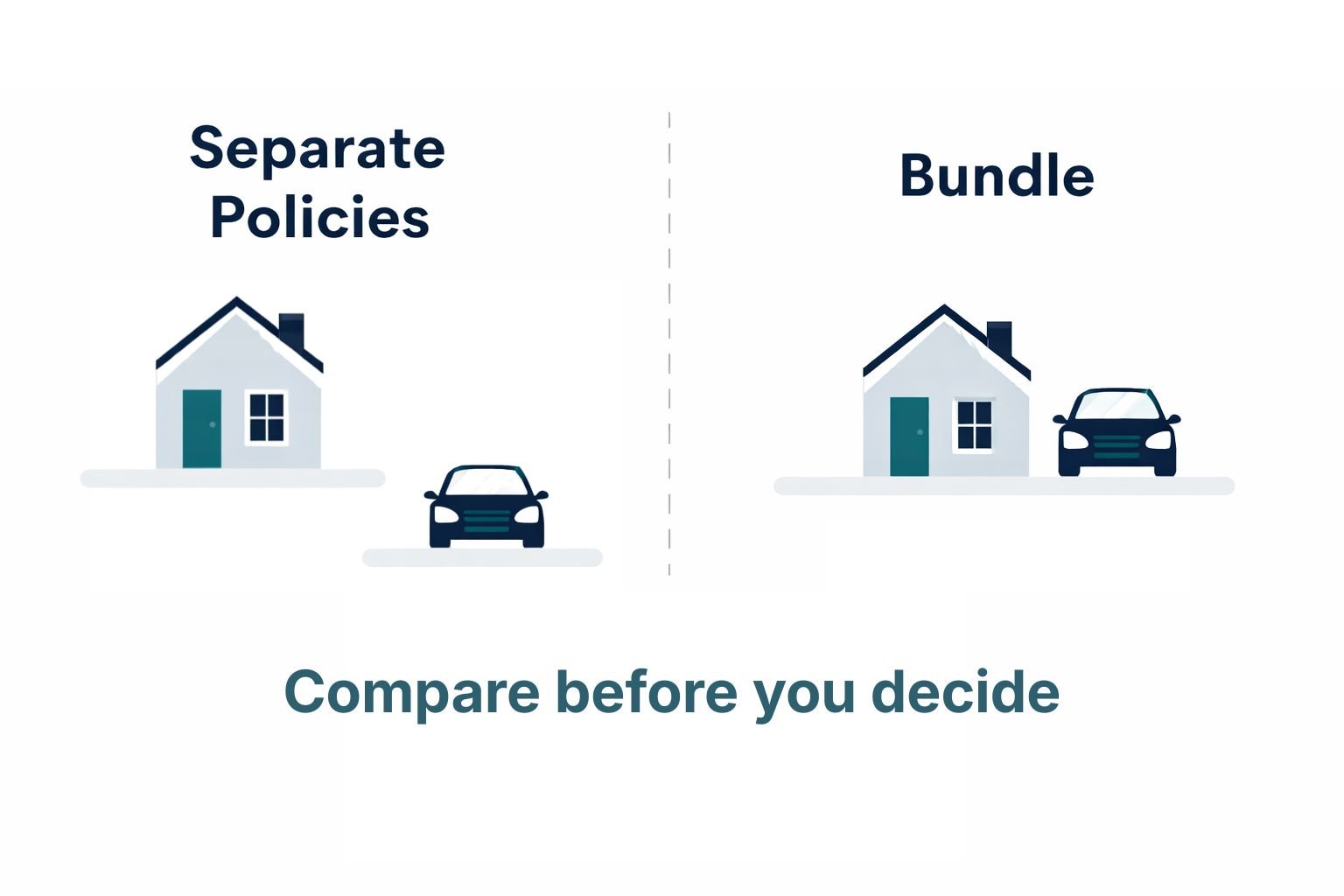
If you own both a home and a car in Washington, you’ve probably heard this advice before:
“Bundle your home and auto insurance and save.”
It's repeated so often it's become received wisdom. But here's what most comparison sites don't tell you: in Washington, bundling is not always the cheapest option. And in some cases, you'll pay meaningfully more by bundling than by shopping carriers separately.
This article breaks down how bundling actually works in Washington, when it saves you money, when it doesn't, and how to run the comparison correctly.
What Is a Home and Auto Insurance Bundle?
Bundling simply means buying both your homeowners insurance and auto insurance from the same carrier. In exchange for the combined business, most insurers offer a multi-policy discount, typically applied to one or both policies.
The mechanics are straightforward. What's less straightforward is whether the math works in your favor.
How Much Can Bundling Save in Washington?
Washington's average annual cost for a bundled home and auto policy is approximately $2,148, according to a MoneyGeek analysis of state rate data. That’s roughly 31% below the national average of $4,050.
Bundle discounts among major carriers in Washington vary significantly:
State Farm offers the largest percentage discount in Washington — up to 15% off auto and 30% off home, with average annual savings of around $521 on a bundle.
PEMCO offers up to 25% off home and up to 14% off auto when bundled, and has the lowest average bundled rate in Washington at approximately $1,762/year.
Allstate offers an 18% auto discount when bundling, with average bundled costs around $1,828/year.
Auto-Owners scores highest for overall bundle quality in Washington, with an average bundled premium of $1,898/year.
On paper, those are real savings. But there's a catch.
The Washington Wrinkle: Sometimes Unbundled Is Cheaper
Here's what makes Washington unusual compared to most states: research consistently shows that buying separate policies from different carriers can be cheaper than any bundle.
According to MoneyGeek's analysis, Washington's cheapest non-bundled combination — selecting the best standalone home insurer and the best standalone auto insurer separately — comes in at approximately $1,580/year, compared to $1,762 for the cheapest bundle (PEMCO). That's a meaningful difference, and it runs counter to what most people assume.
This isn't just a Washington quirk. Insurance.com notes that "in some cases you may get cheaper rates overall when you buy home and car insurance from two different companies." Washington is a state where this dynamic plays out regularly due to the strength of regional carriers.
The reason is straightforward: the multi-policy discount only saves you money if the base rates of the carrier offering the bundle are competitive on both policies. A 20% discount on an overpriced auto rate may still leave you paying more than you would with a lower-priced standalone policy elsewhere.
A Note on PEMCO and Washington's Regional Market
PEMCO deserves special mention here because it's a Washington institution that prices differently than national carriers.
As a mutual company, meaning it's owned by its policyholders, not shareholders, PEMCO reinvests differently than State Farm or Allstate. It offers competitive base rates for its target market: Washington and Oregon residents, particularly those with clean driving records. According to PEMCO's own site, bundling with them can save 25% on your home policy and up to 14% on auto.
But PEMCO's pricing advantages are most pronounced for specific customer profiles: clean driving records, good credit, homeowners in lower-risk areas. If you have violations, are a senior driver, or live in a brush-exposed area (PEMCO has been increasingly non-renewing wildfire-risk properties), the calculus shifts.
The broader point is: Washington has a competitive regional insurance market that doesn't behave the same way as states dominated entirely by national carriers. That makes comparison shopping more important here, not less.
For a direct comparison of how PEMCO stacks up against State Farm on both home and auto, see the PEMCO vs. State Farm breakdown →
When Bundling Still Makes Sense
Despite the above, there are real scenarios where bundling wins.
When your carrier's base rates are competitive on both policies. If a carrier like PEMCO or State Farm prices both your home and auto competitively in your area, the bundle discount adds genuine savings on top of already reasonable rates.
When you have a multi-vehicle or multi-policy loss. One underappreciated benefit of bundling: if a single event damages both your home and your car — say, a fallen tree or a severe storm — having both policies with the same carrier typically means paying only one deductible, not two. That can be worth hundreds of dollars in a claim scenario.
When simplicity has real value for you. One renewal date, one billing relationship, one phone call when something goes wrong. For many homeowners that's genuinely worth something, even if it's not the absolute cheapest option.
When you haven't shopped in more than two years. If you set up your current policies years ago and haven't revisited them, there's a good chance the competitive landscape has shifted. A fresh bundled quote may well beat what you're currently paying, separately or together. If you decide to switch, the guide to switching without a coverage gap walks through how to do it cleanly.
When Bundling May Not Be the Right Call
When one carrier is strong on one policy but not the other. Some insurers price auto very competitively but charge more for home, or vice versa. Mixing a strong home insurer with a strong auto insurer is a legitimate strategy that can outperform any single bundle. A ValuePenguin analysis of Washington carriers notes this explicitly for Allstate: their home insurance rates are competitive, but their auto rates run above the Washington state average.
When loyalty has quietly eroded your discount. Insurance rates typically increase at renewal. The bundling discount you received three years ago may be unchanged while your base rates have climbed, meaning the effective savings are smaller than they appear. Many homeowners stay bundled for years without re-shopping, and find when they finally do that the "discount" is no longer competitive.
When your risk profile is unusual. High-value homes, specialty coverage needs, prior claims, or driving violations can push you toward carriers that specialize in your profile, and those carriers may not offer competitive rates on the other policy type.
How to Compare Correctly
Most people make one mistake when comparing: they compare bundled pricing against their current bundled pricing. That tells you almost nothing.
The right comparison has three steps:
Get quotes for a bundle from two or three carriers (include PEMCO, State Farm, and at least one national carrier)
Get standalone quotes for your home from the best home-only options
Get standalone quotes for your auto from the best auto-only options
Compare the total annual cost of each scenario. Not the discount percentage, the actual dollar amount
The goal is the lowest total cost for the coverage you actually need, not the biggest discount.
The Bottom Line for Washington Homeowners
Bundling is worth comparing, but don't assume it's automatically the right call. Washington's competitive regional market, particularly with carriers like PEMCO and Mutual of Enumclaw, means the "bundle and save" rule of thumb breaks down more often here than in most states.
If you haven't run a full comparison in the past 12–24 months, the numbers may surprise you..
Before you start comparing rates, it's worth knowing whether your current coverage is even set up correctly. A low rate on the wrong coverage is still the wrong coverage.
Take the BeniRate coverage checkup → Answer 5 questions and get a plain-language read on whether your home and auto coverage is doing its job. No personal information required.
Frequently Asked Questions (FAQs)
-
No. Research shows that buying standalone policies from separate carriers can be cheaper than any bundle in Washington, particularly when combining a strong regional home insurer with a competitive national auto carrier. Always compare total annual cost, not just discount percentage.
-
It depends on your profile. PEMCO offers the lowest average bundled rate at approximately $1,762/year and is well-suited to Washington and Oregon residents with clean driving records. State Farm offers the largest percentage discount. Auto-Owners scores highest on overall bundle quality. Your actual best option depends on your home value, location, driving history, and coverage needs.
-
Yes, but you'll typically lose the multi-policy discount on the remaining policy if you move one coverage to another carrier. Factor this into your comparison. The standalone rate you're quoted assumes no bundle, so make sure you're comparing apples to apples.
-
Every 1–2 years, or whenever your situation changes meaningfully. For example, a renovation, adding a vehicle, moving, or a significant change in your credit or driving record.
Data Sources
Rate data and carrier comparisons: MoneyGeek, "Best Home and Auto Bundle Insurance Companies in Washington," December 2025 · Insurance.com, "Cheapest Home and Auto Insurance Bundle in Washington," April 2025 · Insure.com, "Best and Cheapest Companies for Home and Auto Bundles in Washington," December 2025
Carrier discount figures: PEMCO, pemco.com · State Farm, statefarm.com · Allstate, allstate.com
Regional market context: ValuePenguin, "Best and Cheapest Home Insurance in Washington State," December 2025 · AgencyHeight, "PEMCO Insurance Reviews 2026," January 2026
Washington state averages sourced from Quadrant Information Services rate data as reported by the above publications. Individual rates vary based on location, coverage levels, driving history, home value, and other factors.
This article is for educational purposes only and does not constitute insurance advice. BeniRate is an affiliate publisher, not a licensed insurance agency. Coverage availability and requirements vary by insurer.