Pros and Cons of Bundling Home and Auto Insurance
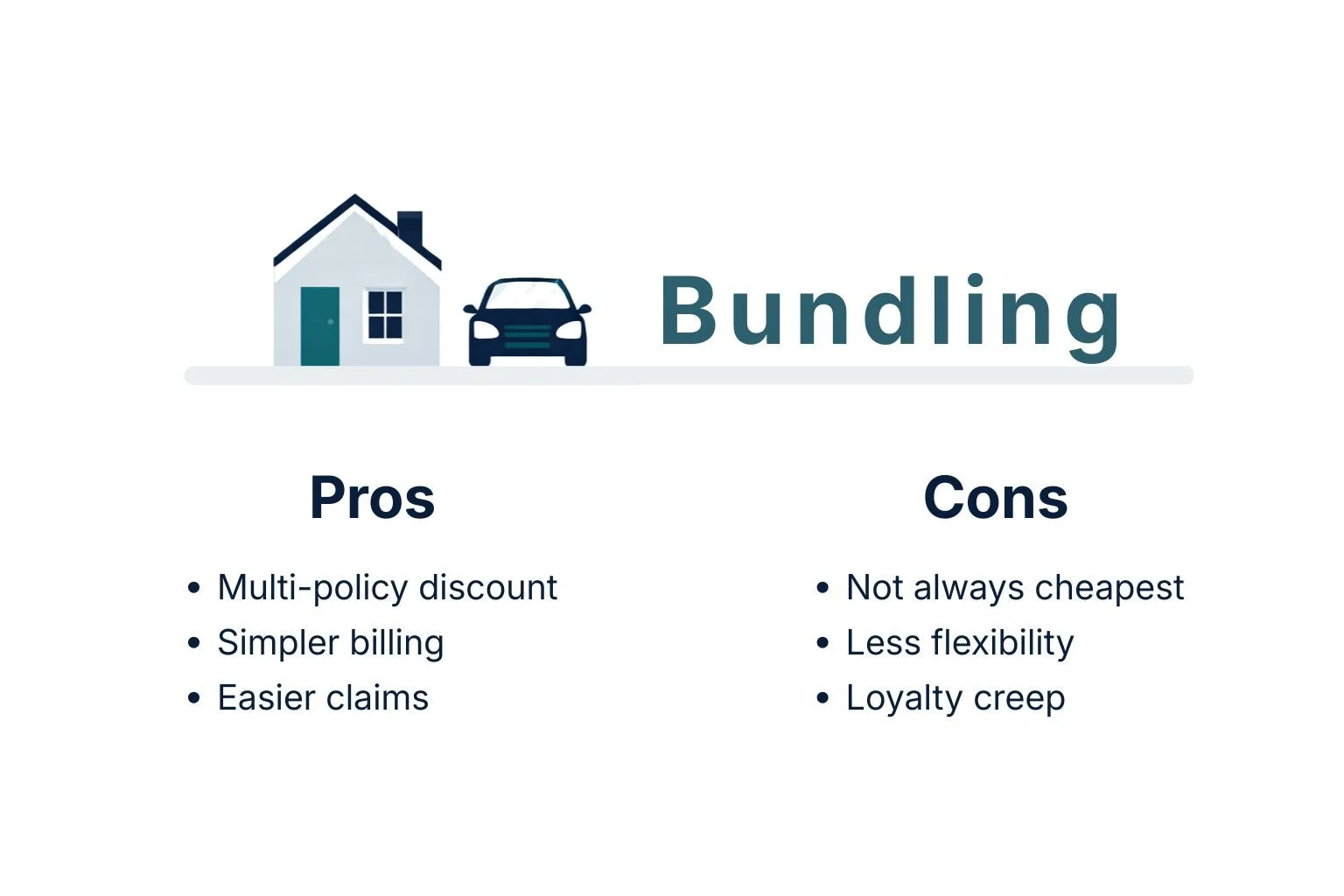
If you own both a home and a car, you’ve probably been told the same thing:
“Bundle your home and auto insurance and save.”
And in many cases, that advice is correct.
But bundling isn’t automatically the best financial decision for every homeowner.
The real answer depends on your rates, your coverage needs, and how often you comparison shop.
In this guide, we’ll break down:
The advantages of bundling home and auto insurance
The potential downsides
When bundling makes sense
When separate policies may be smarter
How to compare options the right way
What Does It Mean to Bundle Home and Auto Insurance?
Bundling simply means purchasing both your homeowners insurance and auto insurance from the same insurance company.
In return, insurers offer a multi-policy discount, often ranging from 10% to 25%.
If you’re new to the concept, you can read our full breakdown here: Home and Auto Insurance Bundle: Is It Actually Cheaper in Washington?
But savings percentages only tell part of the story.
Let’s look at the full picture.
The Pros of Bundling Home and Auto Insurance
1. Multi-Policy Discounts
The most obvious benefit is the discount.
Insurance companies want long-term customers. When you place multiple policies with them, you become less likely to switch, and that loyalty is rewarded with a discount.
For many homeowners, bundling can reduce total annual premiums by a few hundred dollars.
However, remember: A discount only matters if the base rates are competitive.
2. Simpler Billing and Renewals
Bundling often means:
One insurer
One online account
One renewal cycle
One billing system
For busy homeowners, simplicity has real value.
Fewer logins. Fewer due dates. Less administrative friction.
3. Easier Claims Coordination
If a storm damages both your roof and your car, having both policies with one carrier can simplify the process.
Instead of coordinating between two insurers, you may have:
One claims team
Shared documentation
Less back-and-forth
This can reduce stress during already stressful events.
4. Potential Loyalty Benefits
Some insurers offer enhanced perks to bundled customers, such as:
Accident forgiveness
Reduced deductibles over time
Expanded coverage add-ons
These vary by carrier, but they can add long-term value.
The Cons of Bundling Home and Auto Insurance
Now for the part many comparison sites skip.
Bundling is not automatically cheaper, and it’s not always the most flexible option.
1. It’s Not Always the Lowest Total Cost
Sometimes one insurer is strong in auto pricing but weak in homeowners pricing.
In those cases, you might save more by:
Keeping auto with Carrier A
Placing home with Carrier B
Even if the bundle discount sounds attractive.
The key metric is total annual premium for equivalent coverage. Not the advertised percentage discount.
In Washington, this dynamic plays out regularly due to regional carriers like PEMCO. See how PEMCO compares to State Farm on home and auto pricing →
2. Reduced Flexibility
When policies are bundled:
Switching one policy often requires re-rating both
You may hesitate to shop one policy independently
You may accept small increases to avoid disruption
Convenience can unintentionally create inertia.
3. Loyalty Can Lead to Overpaying
Many homeowners bundle once and then stop shopping.
Over time:
Rates can increase
Risk models change
Competitors become more competitive
If you haven’t re-compared rates in 2–3 years, there’s a reasonable chance you’re paying more than necessary.
Bundling doesn’t eliminate the need to periodically compare. If you're ready to make a change, here's how to switch home insurance without a coverage gap.
4. Coverage Needs Can Differ
Homeowners insurance and auto insurance protect very different risks.
Your home coverage may need higher liability limits.
Your auto policy may require different deductibles.
Umbrella policies may factor into both.
When bundled, it’s easy to focus on discount rather than coverage alignment.
When Bundling Makes the Most Sense
Bundling tends to work well if:
You have standard coverage needs
You value simplicity
Your driving and claims history are clean
You haven’t comparison-shopped recently
For many middle-to-upper income homeowners, bundling strikes a good balance between cost and convenience. Learn which insurance companies are competitive for bundled rates.
When Keeping Policies Separate May Be Smarter
You might consider separate policies if:
You own a high-value or specialty home
You have unique coverage requirements
You’re aggressively optimizing for lowest possible cost
You’re comfortable managing multiple providers
Washington homeowners have more options here than most states. The strength of regional carriers means unbundling can genuinely outperform any bundle in Washington, particularly if you haven't compared rates recently.
Sometimes specialization beats consolidation.
How to Compare Bundled vs Separate Policies Correctly
If you’re evaluating options, avoid this common mistake: Comparing your current bundle to a new bundle.
Instead:
Get a bundled quote.
Get separate quotes for home and auto.
Match coverage limits exactly.
Compare total annual cost, not just discount percentage.
Review deductibles and endorsements carefully.
The goal is clarity.
Not just savings.
Before comparing, it's worth knowing whether your current coverage is set up correctly in the first place.
Take the free coverage checkup → 2 minutes. No personal info required.
Final Verdict: Should You Bundle Home and Auto Insurance?
Bundling is often convenient. It’s frequently cheaper. But it’s not automatically the best choice in every scenario.
The smartest approach is simple: Compare.
If you’re a homeowner with both policies, running a bundled comparison every 1–2 years is one of the easiest ways to check whether you’re overpaying.
Bundling should be a strategic choice.
Not a default one.
Frequently Asked Questions (FAQs)
-
No. While discounts typically apply, base rates vary significantly between insurers. Always compare total annual premiums.
-
Savings commonly range from 10% to 25%, but actual dollar savings depend on your location, coverage, and insurer.
-
In some cases, having both policies with one insurer can simplify claims coordination, especially if one event impacts both home and auto.