When NOT to Bundle Home and Auto Insurance
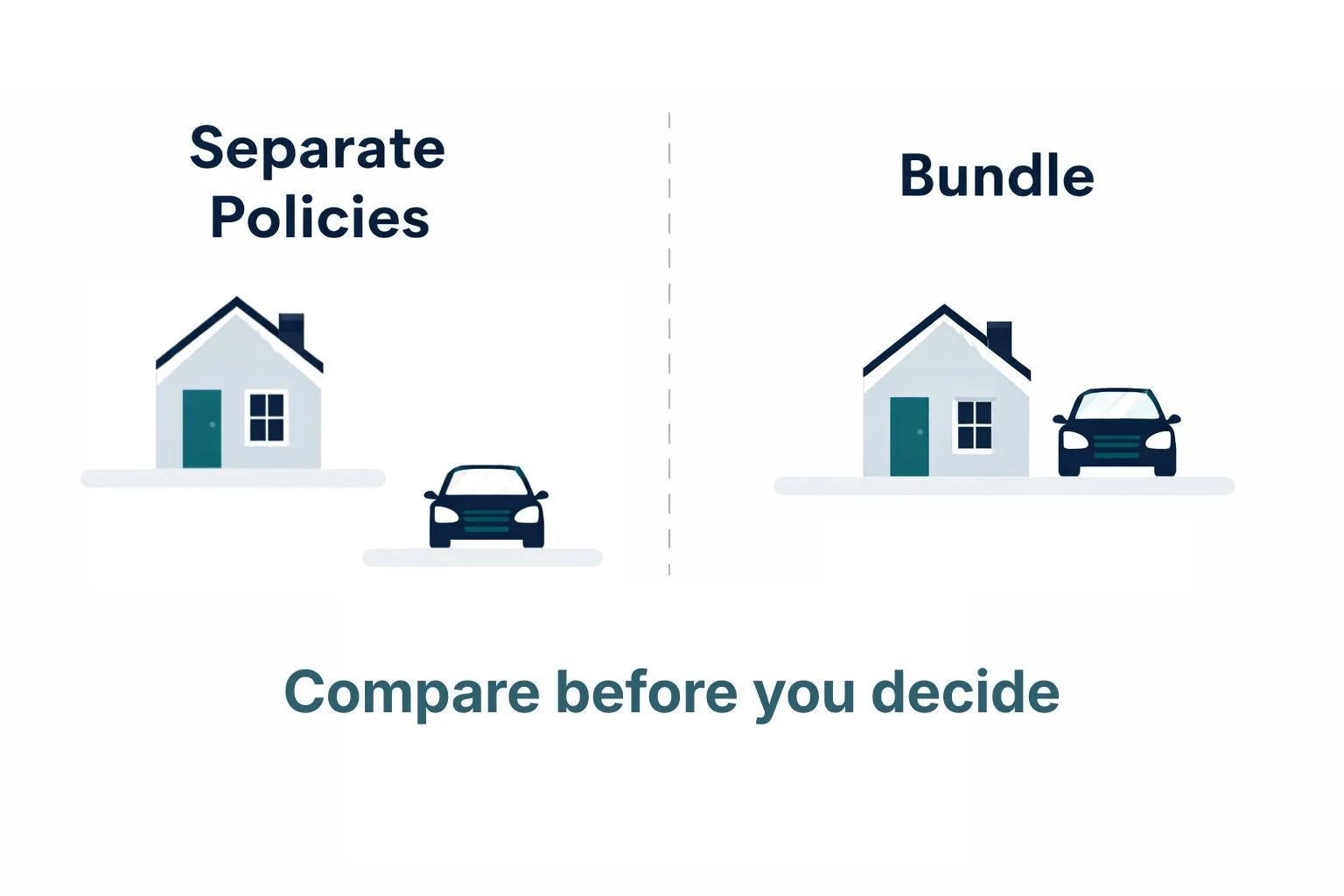
Bundling home and auto insurance is often marketed as the smart move.
And in many cases, it is.
But bundling is not automatically the best financial decision for every homeowner.
There are situations where keeping your policies separate can actually cost less or provide better coverage flexibility.
If you’re evaluating whether to bundle, here are the scenarios where it may not make sense.
What Bundling Usually Offers
Before diving into when to avoid bundling, it’s helpful to recap what bundling typically provides:
A multi-policy discount (often 10%–25%)
Simplified billing
Coordinated claims handling
Potential loyalty perks
For many households, those benefits are meaningful.
But there are exceptions.
1. When One Company Is Strong in Auto but Weak in Home (or Vice Versa)
Insurance companies don’t price all lines of coverage equally.
Some insurers are highly competitive for auto insurance but less competitive for homeowners coverage.
Others specialize in home policies but don’t offer the best auto pricing.
If:
Carrier A offers excellent auto pricing
Carrier B offers better home pricing
You may save more by keeping policies separate.
The only way to know is to compare total annual premiums, not just discount percentages.
In Washington, this plays out more often than in most states. Regional carriers can outperform national bundles on total cost — particularly for homeowners who haven't gotten a PEMCO quote.
2. When You Own a High-Value or Unique Property
If your home has:
High rebuild costs
Specialty materials
Unique endorsements
Custom liability requirements
You may benefit from a carrier that specializes in homeowners insurance.
Bundling with a generalist insurer may reduce customization flexibility.
In these cases, getting the right coverage matters more than convenience.
3. When You’re Optimizing Aggressively for Lowest Possible Cost
Bundling is convenient.
But if your primary goal is achieving the absolute lowest premium, separating policies sometimes provides more pricing leverage.
Some homeowners actively:
Re-shop auto annually
Re-shop home every 1–2 years
Move policies independently
Bundling can create friction in that optimization process.
If you prefer flexibility, separate policies may make sense.
4. When Your Driving Record or Claims History Is Complicating Pricing
If you have:
Recent at-fault accidents
Multiple home claims
High-risk driving factors
Bundling can sometimes group risks in a way that limits pricing flexibility.
In certain cases, placing auto and home with different carriers can isolate risk more effectively.
This is profile-specific, but worth considering.
5. When Loyalty Is Quietly Increasing Your Rates
Many homeowners bundle once then stop shopping.
Over time:
Rates can rise
New competitors may become more competitive
Market pricing shifts
If you haven’t compared rates in 2–3 years, bundling may no longer be your lowest-cost option.
Bundling works best when paired with periodic comparison shopping.
When you're ready to make a move, here's how to switch carriers without a coverage gap.
6. When Coverage Needs Differ Significantly
Home and auto insurance protect very different risks.
Your home policy may require:
Higher liability limits
Replacement cost endorsements
Water backup coverage
Your auto policy may prioritize:
Deductible structure
Uninsured motorist coverage
Vehicle-specific needs
If your policies have unique or specific needs, separating them might be a better move.
A Note for Washington Homeowners Washington's insurance market behaves differently from most states. The presence of strong regional carriers, particularly PEMCO, means the standard "bundle and save" assumption breaks down more often here. In fact, Washington's cheapest combination is often two separate policies from different carriers. If you haven't gotten a regional quote recently, the PEMCO vs. State Farm comparison is a good place to start.
Is Bundling Ever a Bad Idea?
Not necessarily.
Bundling is often:
Convenient
Competitively priced
Logistically simpler
But it should be a decision, not an assumption.
The smartest approach isn’t automatically bundling or automatically separating. It’s comparing both options.
How to Decide Whether to Bundle or Not
If you’re unsure, follow this approach:
Get bundled quotes from multiple insurers.
Get separate home and auto quotes.
Match coverage limits exactly.
Compare total annual premium.
Review deductibles and exclusions.
If bundling wins on both cost and coverage — great.
If separate policies cost less — that’s valuable clarity.
Washington homeowners should also get a PEMCO quote before deciding. It's not on national comparison platforms but is frequently the most competitive option in the state.
Before you decide whether to bundle or separate, it's worth knowing whether your current coverage is actually doing its job — regardless of which carrier it's with.
Take the free coverage checkup → Answer 5 questions. Get a plain-language read on your home and auto coverage. No personal info, no spam calls.
Final Thoughts: Bundling Should Be Strategic
Bundling home and auto insurance is often marketed as the default smart move.
But the smarter move is comparison.
For many homeowners, bundling provides real savings and convenience. For others, separating policies can offer better pricing or flexibility. Read more about the pros and cons of bundling home and auto insurance.
The difference isn’t universal.
It’s personal.
And that’s why reviewing your options every couple of years is one of the simplest financial habits you can build.
Frequently Asked Questions (FAQs)
-
Yes. If one insurer offers significantly better pricing for one policy, separating home and auto coverage may reduce total cost. If you have unique needs for your car or home, separating policies might also give you the right coverage.
-
It can. Switching one policy may require re-rating both, which may discourage comparison.
-
Yes. Comparing both structures ensures you’re choosing thoughtfully based on total cost and coverage.